
Introduction
Software deployment failures and infrastructure instability continue to impact modern engineering teams, especially as applications scale across cloud-native environments. Traditional DevOps pipelines often struggle with delayed issue detection, manual intervention, and inconsistent deployment processes. AI-powered DevOps platforms solve these challenges by introducing intelligent automation, predictive analytics, and real-time operational visibility into deployment workflows.
The Growing Challenge of Deployment Downtime
Organizations deploying software multiple times per day face increasing operational complexity. Small configuration issues, dependency failures, or infrastructure bottlenecks can quickly escalate into production outages. Even a few minutes of deployment downtime can affect customer experience, revenue, and engineering productivity. Businesses now require proactive systems capable of identifying risks before failures occur.
How AI Improves DevOps Operations
AI-powered DevOps systems continuously analyze deployment logs, infrastructure metrics, and pipeline activity to identify anomalies in real time. Instead of relying solely on reactive monitoring, intelligent systems can predict deployment failures, recommend remediation actions, and automate rollback procedures. This dramatically reduces manual troubleshooting and improves operational resilience.
Automated CI/CD Pipelines at Scale
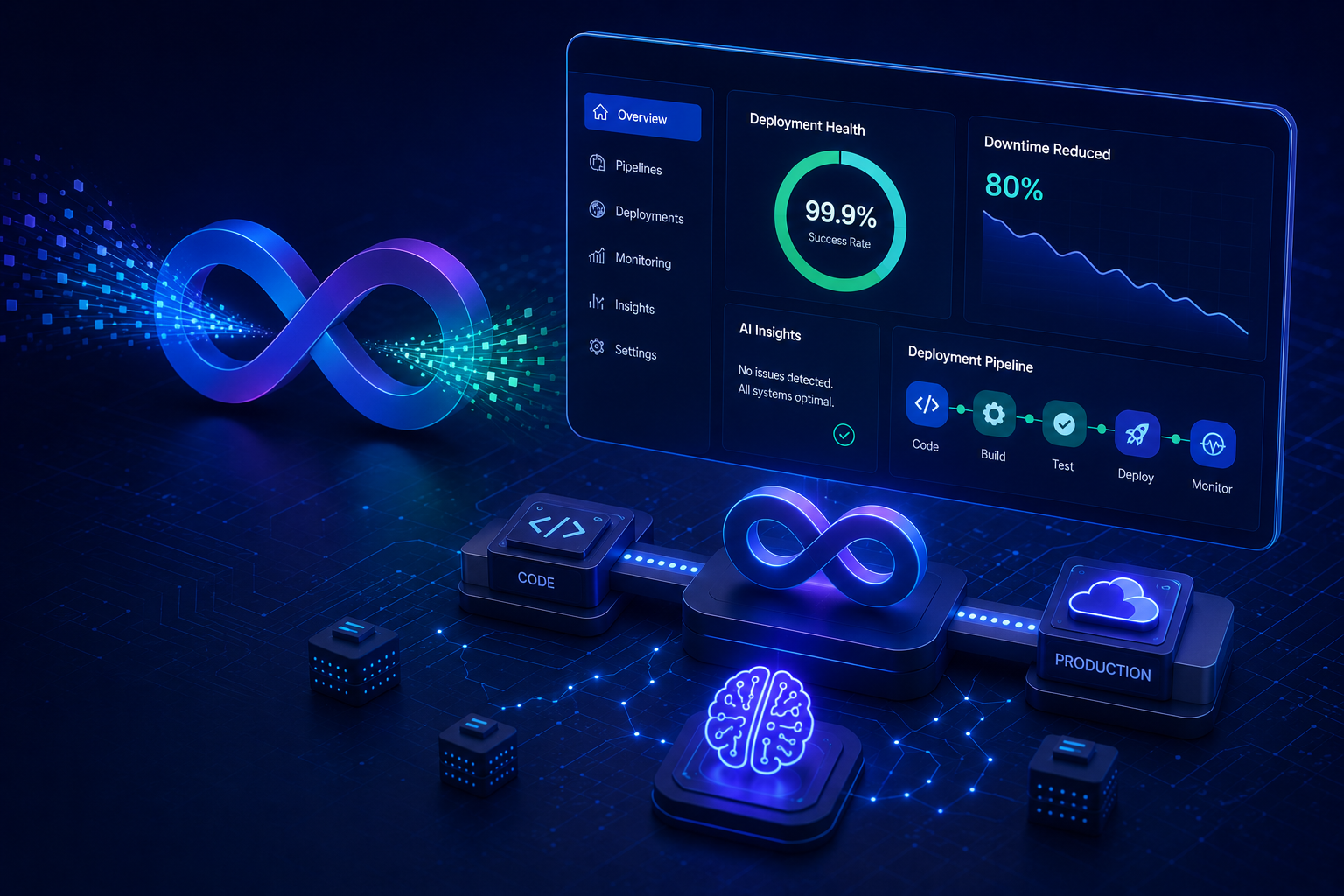
Modern AI DevOps platforms streamline Continuous Integration and Continuous Deployment workflows by automating testing, validation, infrastructure provisioning, and deployment approvals. Intelligent automation enables faster release cycles while maintaining deployment consistency across staging and production environments.
Real-Time Monitoring and Predictive Analytics
Advanced monitoring dashboards provide engineering teams with real-time visibility into deployment health, server utilization, API performance, and infrastructure reliability. Predictive analytics helps teams detect unusual patterns before incidents impact production systems, allowing proactive mitigation instead of reactive recovery.
Business Impact of AI-Driven DevOps
Organizations implementing AI-powered DevOps platforms often achieve substantial improvements in deployment success rates, infrastructure stability, and operational efficiency. Reduced downtime leads to improved customer satisfaction, faster product delivery, lower operational costs, and enhanced engineering productivity. AI also enables teams to focus more on innovation rather than repetitive operational tasks.
Future of Intelligent DevOps Platforms
The future of DevOps is increasingly driven by AI, automation, and self-healing infrastructure systems. As machine learning models become more advanced, DevOps platforms will continue evolving toward autonomous infrastructure optimization, intelligent incident response, and predictive operational management. Businesses adopting AI DevOps early gain a significant competitive advantage in scalability and software delivery speed.
Conclusion
AI-powered DevOps platforms are redefining how organizations manage software delivery and infrastructure operations. By combining predictive analytics, automation, CI/CD intelligence, and real-time monitoring, businesses can drastically reduce deployment downtime and improve release reliability. As digital infrastructure continues to scale, intelligent DevOps systems will become essential for maintaining operational excellence and accelerating innovation.