
Introduction
Customer expectations for instant, personalized, and always-available support continue to rise across every industry. Traditional customer service systems often struggle with slow response times, manual ticket management, fragmented communication channels, and operational inefficiencies. AI-powered workflow automation platforms are transforming customer support by automating repetitive tasks, streamlining workflows, and enabling intelligent customer interactions across multiple channels. Modern AI support systems now help businesses improve efficiency, reduce costs, and deliver better customer experiences at scale. :contentReference[oaicite:0]{index=0}
The Growing Need for Intelligent Customer Support
As businesses scale, customer support teams face increasing ticket volumes, repetitive inquiries, and rising service expectations. Manual support workflows often create delays, inconsistent responses, and operational bottlenecks. AI workflow automation platforms address these challenges by intelligently managing support requests, automating routine interactions, and assisting support agents with real-time recommendations and contextual insights. :contentReference[oaicite:1]{index=1}
How AI Workflow Automation Works
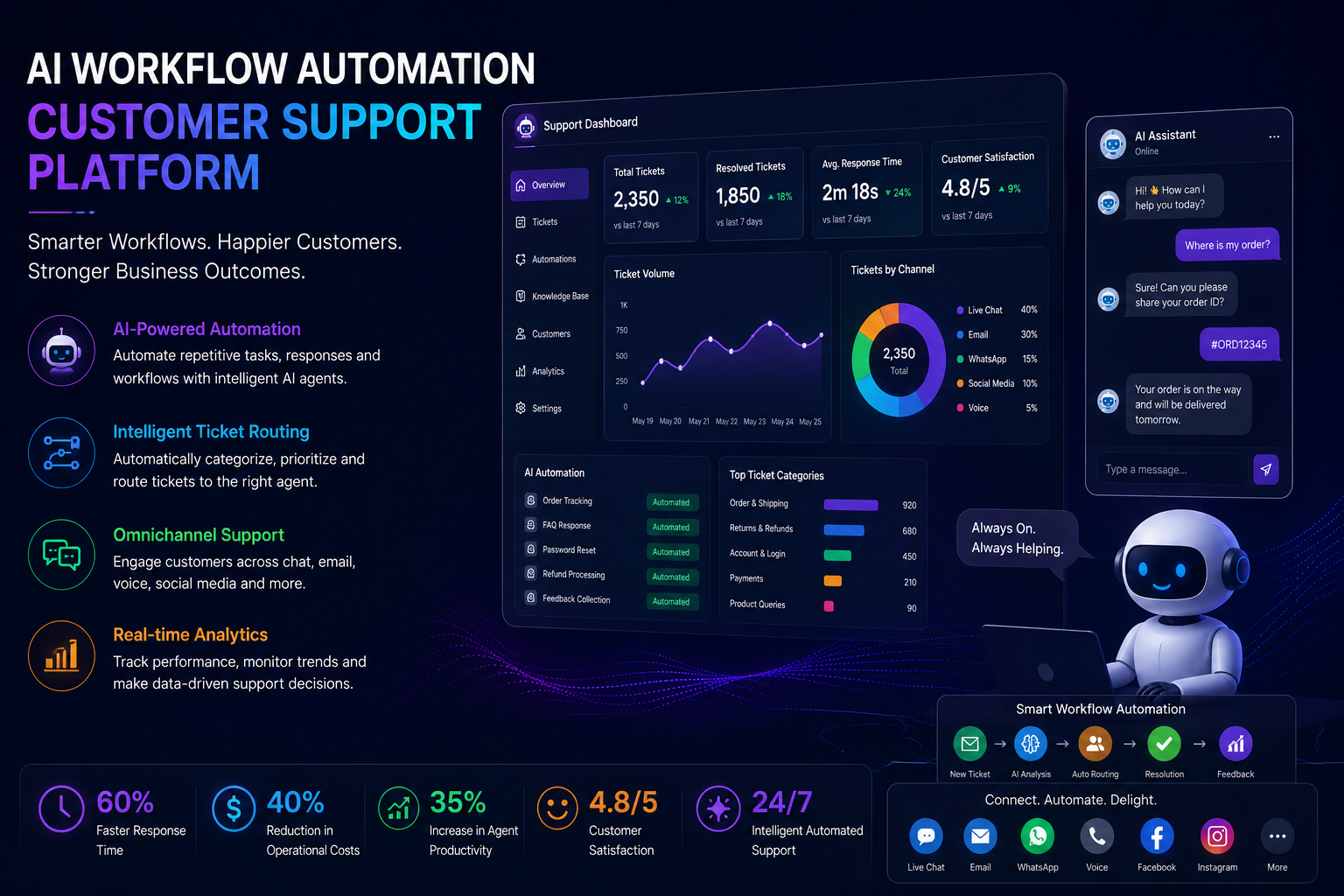
AI-driven customer support platforms use machine learning, natural language processing, and intelligent workflow engines to automate customer interactions and operational processes. These systems can classify tickets, detect customer intent, prioritize urgent requests, route cases to appropriate teams, and generate automated responses instantly. Advanced platforms also integrate with CRMs, helpdesks, payment systems, and knowledge bases to execute end-to-end workflows with minimal human intervention. :contentReference[oaicite:2]{index=2}
Omnichannel Customer Support Automation
Modern support platforms unify communication across chat, email, voice, WhatsApp, social media, and ticketing systems. AI automation ensures customers receive consistent support experiences regardless of the communication channel they choose. Omnichannel AI systems can maintain conversation context, transfer tickets between channels seamlessly, and provide continuous 24/7 assistance without increasing operational overhead. :contentReference[oaicite:3]{index=3}
Intelligent Ticket Routing and Resolution
One of the most impactful capabilities of AI workflow automation is intelligent ticket routing. AI systems analyze sentiment, urgency, issue categories, and historical patterns to assign support requests to the most suitable agents or automated workflows. This significantly reduces response times and improves first-contact resolution rates. AI can also automate repetitive tasks such as password resets, refund processing, order tracking, and FAQ handling. :contentReference[oaicite:4]{index=4}
Real-Time Analytics and Operational Insights
AI-powered support platforms provide real-time dashboards and analytics that help organizations monitor customer satisfaction, ticket trends, agent productivity, and workflow performance. Predictive analytics enables businesses to identify support bottlenecks early, optimize staffing requirements, and improve customer engagement strategies using data-driven insights. :contentReference[oaicite:5]{index=5}
Balancing AI Automation with Human Support
While AI automation improves efficiency, human collaboration remains critical for handling sensitive, complex, or emotionally nuanced customer interactions. The most effective support systems combine AI-powered automation with seamless escalation to human agents when needed. Hybrid support models ensure customers receive fast responses without sacrificing empathy, personalization, or decision-making quality. :contentReference[oaicite:6]{index=6}
The Future of AI Customer Support Platforms
AI workflow automation is evolving rapidly toward autonomous customer support ecosystems powered by intelligent AI agents. Emerging platforms are introducing proactive issue resolution, voice AI agents, sentiment-aware automation, self-learning workflows, and predictive customer service models. Businesses that adopt AI-driven support automation early are likely to gain significant advantages in scalability, customer satisfaction, and operational efficiency. :contentReference[oaicite:7]{index=7}
Conclusion
AI workflow automation platforms are fundamentally changing how businesses manage customer support operations. By combining intelligent automation, omnichannel communication, real-time analytics, and AI-driven workflows, organizations can deliver faster, smarter, and more scalable customer experiences. As AI technology continues to advance, customer support platforms will increasingly evolve into proactive, intelligent systems capable of resolving issues efficiently while enhancing customer satisfaction and operational performance. :contentReference[oaicite:8]{index=8}