
Introduction
Drone technology is rapidly transforming how governments, public safety agencies, and enterprises manage aerial operations. Beyond Visual Line of Sight (BVLOS) drone systems allow organizations to conduct long-range drone missions without requiring pilots to maintain direct visual contact with the aircraft. In Canada, modern BVLOS platforms are enabling faster emergency response, infrastructure monitoring, industrial inspections, and real-time situational awareness while maintaining strict aviation compliance requirements.
What Is a BVLOS Drone Management Platform?
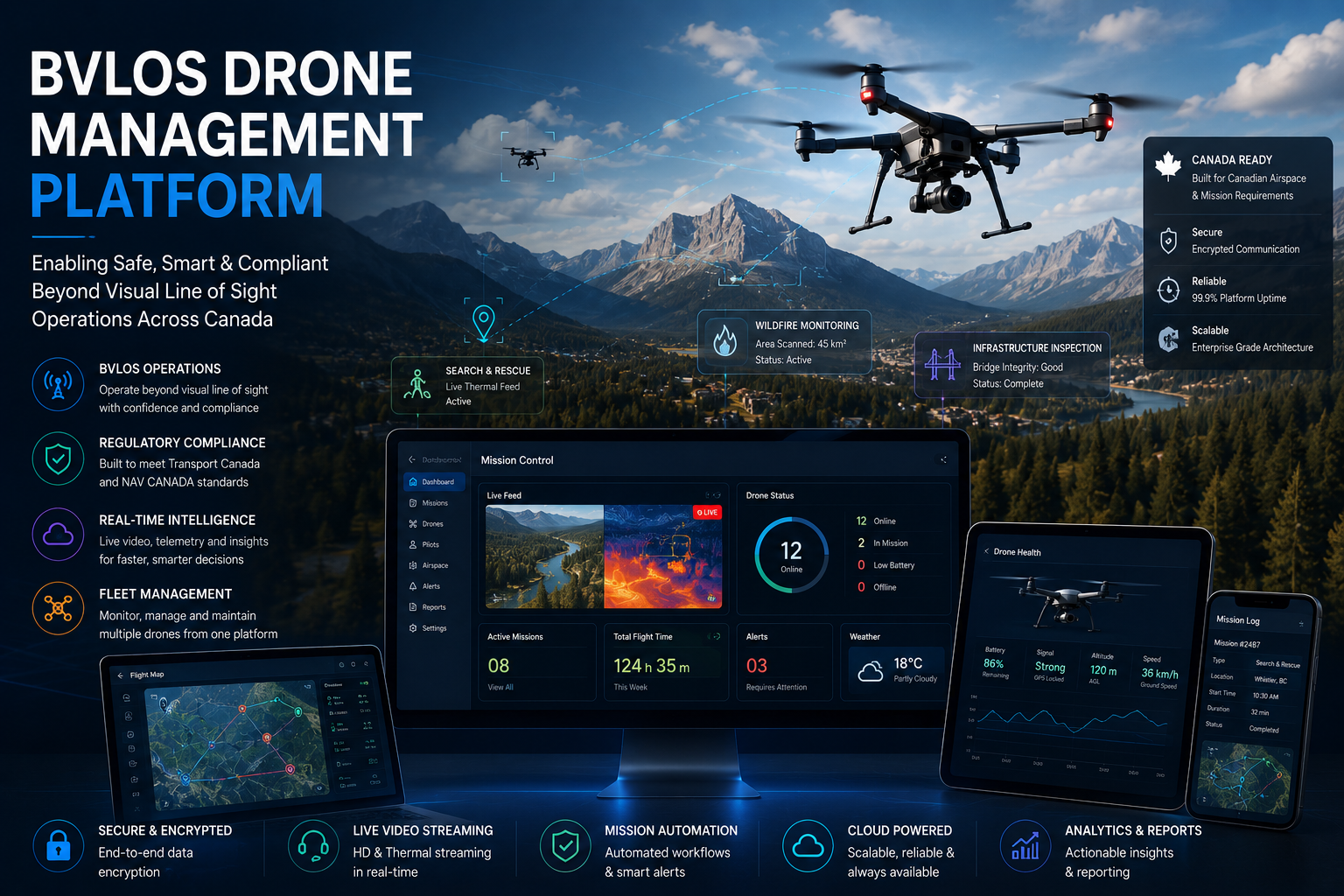
A BVLOS drone management platform is a centralized system designed to manage long-range drone operations through secure cloud-based software, intelligent telemetry systems, and regulatory oversight tools. These platforms allow certified pilots and organizations to coordinate missions remotely, monitor live video feeds, manage drone fleets, and maintain operational safety standards during complex aerial operations.
Improving Emergency Response Through Real-Time Aerial Intelligence
Emergency response teams increasingly rely on drone systems to gain real-time visibility during incidents such as fires, floods, traffic accidents, search-and-rescue operations, and hazardous situations. BVLOS drone platforms help agencies deploy drones quickly while streaming live HD and thermal imagery directly to command centers. Faster aerial intelligence enables responders to assess risks more effectively and make quicker operational decisions.
Centralized Command and Fleet Management
Modern drone management platforms provide centralized dashboards for mission scheduling, pilot coordination, drone health monitoring, and compliance tracking. Operators can manage multiple drone fleets simultaneously while maintaining visibility into airspace conditions, mission status, battery performance, and operational telemetry from a single interface.
Regulatory Compliance and Operational Safety
BVLOS drone operations require strict compliance with aviation regulations and airspace management protocols. Advanced drone platforms integrate approval workflows, automated logging systems, encrypted communications, and operational safeguards that help organizations align with Transport Canada and NAV CANADA requirements. This reduces operational risk while ensuring traceability and accountability for every flight mission.
AI and Automation in Drone Operations
AI-powered drone systems are improving flight planning, anomaly detection, obstacle avoidance, and predictive maintenance capabilities. Intelligent automation helps reduce manual operational overhead while enabling safer and more scalable drone deployments. Automated alerts and real-time analytics also help operators respond quickly to environmental changes and mission-critical incidents.
Industrial and Infrastructure Applications
Beyond emergency response, BVLOS drone platforms are widely used for infrastructure inspections, utility monitoring, environmental surveillance, construction site management, and industrial asset inspections. Organizations can inspect remote or hazardous locations safely while reducing operational costs and minimizing risks for field personnel.
The Future of BVLOS Operations in Canada
As drone regulations evolve and airspace infrastructure improves, BVLOS operations are expected to become a critical part of public safety and commercial aviation ecosystems in Canada. Future advancements will likely include autonomous drone coordination, AI-assisted airspace management, intelligent docking stations, and fully integrated drone traffic management systems capable of supporting large-scale autonomous aerial networks.
Conclusion
BVLOS drone management platforms are reshaping how organizations deploy aerial intelligence and manage complex drone operations. By combining real-time monitoring, AI-driven automation, secure communications, and regulatory compliance systems, these platforms enable safer, faster, and more efficient drone missions across emergency response, infrastructure management, and industrial operations. As adoption grows, BVLOS technology will continue playing a major role in the future of connected aerial ecosystems.